The problem
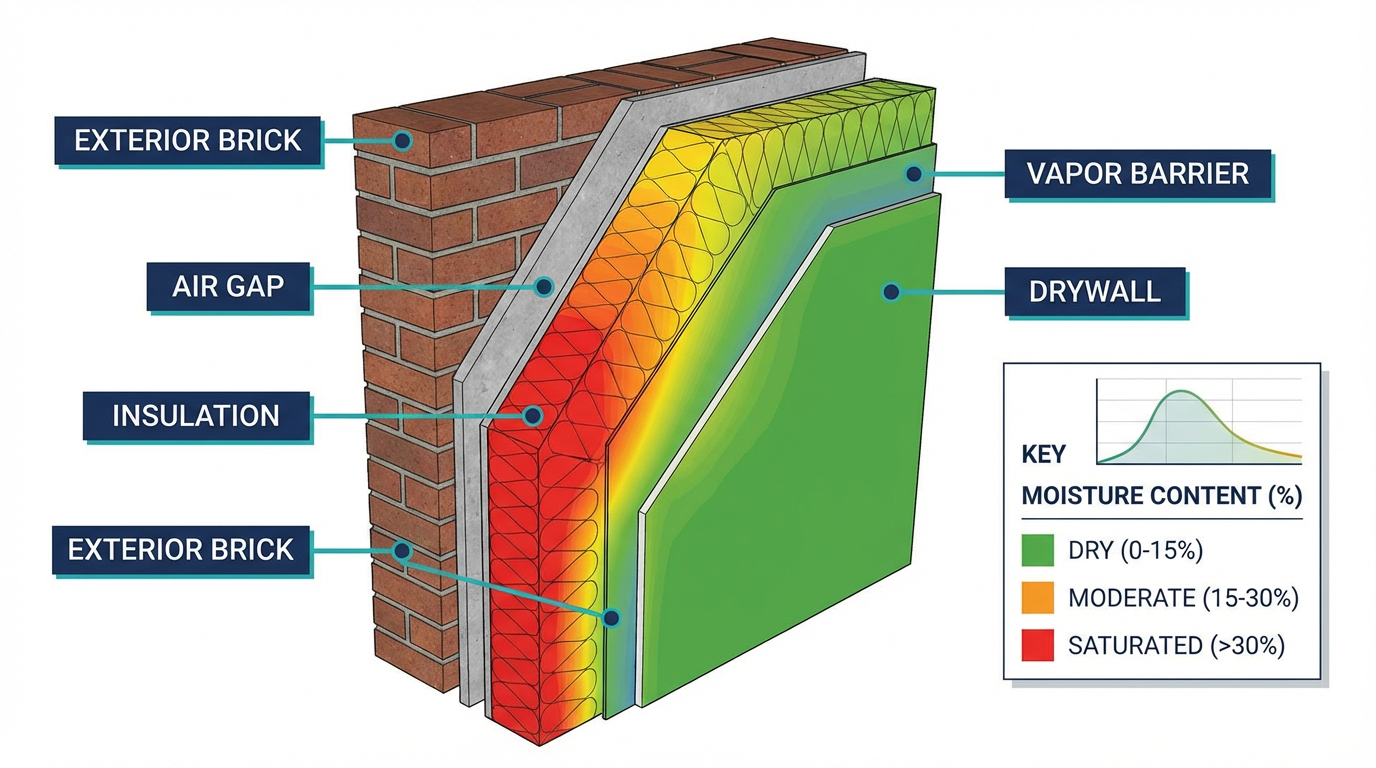
Condensation and ventilation failure drive mould growth, timber decay and building-related health complaints. Causation often involves retrofit insulation, changed occupancy patterns or mechanical ventilation system failure.
Since the push for energy efficiency and retrofit insulation, condensation problems have become epidemic. Airtightness improvements without adequate ventilation create environments where relative humidity exceeds safe limits. Mould growth follows. Landlord-tenant disputes frequently turn on whether condensation is caused by a building defect (the landlord's responsibility) or occupant behaviour (lifestyle condensation). Without quantified environmental data, this question cannot be answered defensively.
The risk
Disputes turn on whether condensation or construction defect is the primary cause. Ventilation performance, air exchange rates and dew point conditions must be quantified — not estimated.
In Housing Act disrepair claims, landlords face significant liability if condensation is attributable to inadequate ventilation provision. Conversely, tenants may be responsible if ventilation is adequate but unused. Our forensic approach quantifies ventilation performance and environmental loading to answer this question with data.
Our investigation
We deploy CO₂ and humidity data loggers, measure air exchange rates, conduct psychrometric analysis and model dew point conditions. We assess mechanical ventilation system performance where installed.
- CO₂ monitoring to quantify actual ventilation rates and occupancy patterns
- Temperature and relative humidity data logging over 7–28 days
- Dew point modelling across wall, window and ceiling surfaces
- Mechanical ventilation system assessment (MVHR, extract fans, trickle vents)
- Building fabric assessment for thermal bridging and insulation defects
- FLIR thermal imaging to identify cold bridges and condensation risk zones
- Psychrometric analysis and air exchange rate calculation
Findings
Environmental loading, ventilation shortfalls and condensation risk are quantified with recorded data. Dew point modelling identifies which surfaces are at risk and under what conditions. Causation is attributed with confidence.
What the report delivers
- ✓ Ventilation performance analysis with measured air exchange rates
- ✓ Environmental data logs — temperature, humidity, CO₂
- ✓ Dew point and condensation risk assessment
- ✓ Thermal images showing cold bridges and insulation defects
- ✓ Causation analysis — building defect vs lifestyle condensation
- ✓ Remedial and design guidance
- ✓ Suitable for Housing Act disrepair claims and landlord-tenant disputes
Who commissions this investigation?
Landlords
Defending against disrepair claims where tenants allege condensation is caused by inadequate ventilation or building defects.
Tenants
Living with mould and condensation and needing independent evidence that the problem is a building defect rather than lifestyle.
Housing associations
Investigating condensation and mould complaints across housing stock, particularly post-retrofit properties.
Developers
Facing warranty claims related to condensation in new-build or recently refurbished properties.
Solicitors
Building evidence for Housing Act disrepair, Section 11 or Homes (Fitness for Human Habitation) Act claims.
Frequently asked questions
- What causes condensation in a well-insulated home?
- Insulation reduces heat loss but also reduces air exchange if not paired with adequate ventilation. Moisture from cooking, bathing and breathing accumulates, relative humidity rises, and condensation forms on cold surfaces — typically windows, external wall corners and behind furniture.
- Can you prove whether condensation is the landlord's or tenant's fault?
- We quantify ventilation performance, environmental conditions and building fabric performance. If ventilation provision is inadequate or the building has thermal defects, the cause is attributable to the building. If ventilation is adequate and conditions are driven by occupancy, the data shows that too.
- How long do data loggers need to be in place?
- Typically 7–14 days for a clear picture. In some cases, 28 days captures a wider range of weather conditions and occupancy patterns. Loggers record continuously and are non-invasive.
Where we work
Condensation survey Hampshire. Ventilation audit Winchester. Condensation survey London. Condensation investigation Southampton. Mould and condensation expert near me. Ventilation assessment London.
Related investigations
Commission this investigation
Request an initial case review. We respond to serious enquiries promptly.
NAP: Independent Building Science and Forensics, 15 Rockstone Pl, Southampton SO15 2EP. Tel: +44 7555 809800. Email: enquiries@independentbuildingforensics.co.uk.