The problem
Building-related health complaints — headaches, respiratory issues, fatigue — require objective assessment of indoor air quality: CO₂ levels, volatile organic compounds (VOCs), mould presence and ventilation performance. Subjective symptoms need quantified data.
Sick building syndrome (SBS) and building-related illness (BRI) are diagnosed by exclusion. Environmental monitoring provides the data needed to determine whether a building's indoor air quality falls below acceptable standards. Without instrument-verified measurement, claims remain subjective and unresolvable. Indoor air quality testing London and Hampshire requires a forensic approach.
The risk
Employers, landlords, insurers and building managers need defensible evidence of environmental conditions. Health and safety liability, Employment Act obligations and Housing Act duties all intersect with indoor air quality.
In commercial settings, poor IAQ can result in HSE enforcement, employee claims and reputational damage. In residential settings, mould and poor ventilation are increasingly the subject of disrepair litigation. Our reports provide the quantified evidence needed for each scenario.
Our investigation
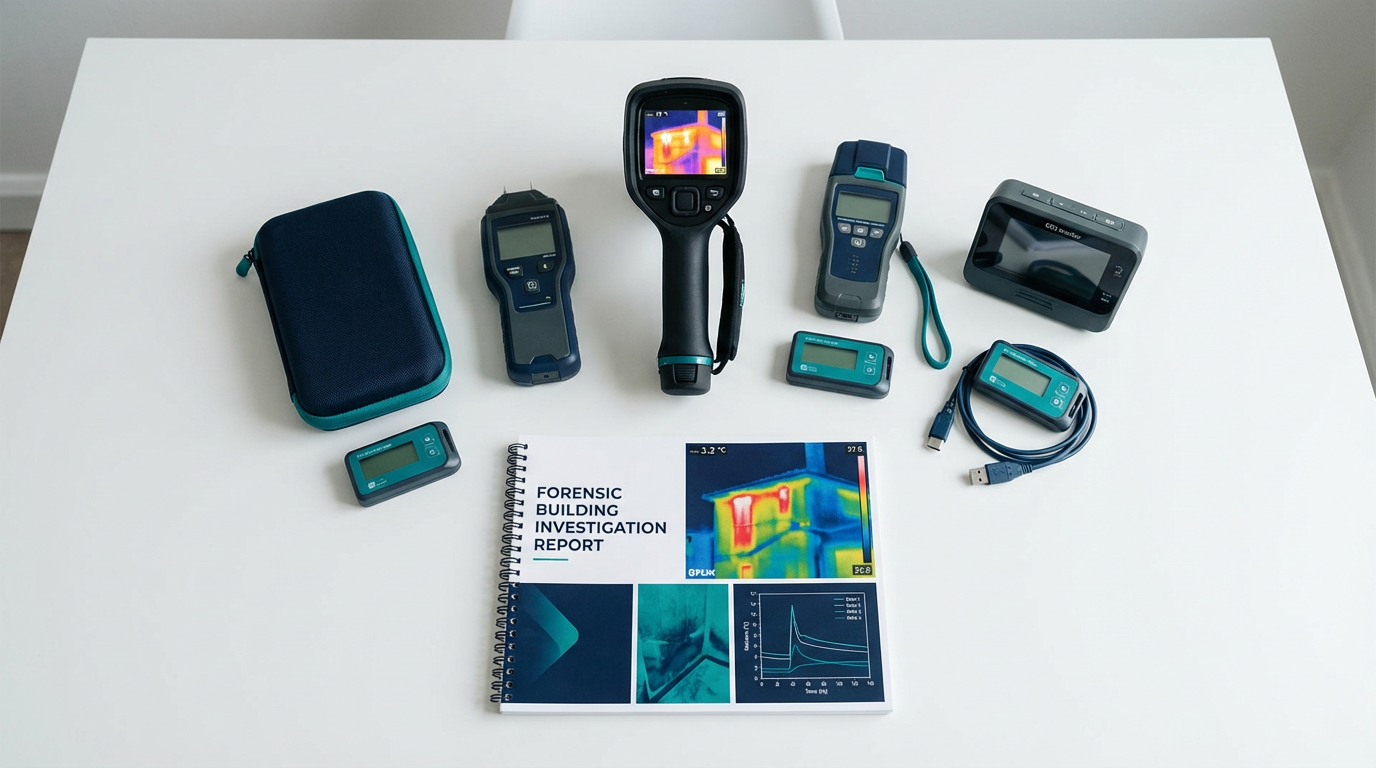
We deploy CO₂, VOC and particulate monitors, assess ventilation performance, conduct mould inspection and surface sampling, and log environmental data over representative periods.
- CO₂ monitoring — continuous measurement to quantify ventilation adequacy
- VOC detection — total VOC screening and, where indicated, speciation
- Temperature and relative humidity logging
- Mould inspection — visual, moisture mapping and surface sampling where indicated
- Ventilation system assessment — mechanical and natural
- Particulate monitoring where relevant (PM2.5, PM10)
- Data analysis against CIBSE, WHO and HSE guideline levels
Findings
Environmental data is logged, analysed and interpreted against recognised standards. Links between measured conditions and reported symptoms are assessed with appropriate scientific caveats.
What the report delivers
- ✓ IAQ data — CO₂, VOC, temperature, humidity, particulates
- ✓ Comparison against CIBSE, WHO and HSE guideline levels
- ✓ Ventilation performance assessment
- ✓ Mould and surface sampling results where applicable
- ✓ Interpretation and causation commentary
- ✓ Remedial and management guidance
- ✓ Suitable for employer liability, landlord-tenant and insurance contexts
Who commissions this investigation?
Employers
Responding to employee health complaints or HSE enquiries about workplace air quality.
Landlords
Investigating mould and air quality complaints from tenants, particularly in HMOs or converted properties.
Schools and institutions
Assessing classroom and institutional air quality following health complaints or ventilation concerns.
Solicitors
Building evidence for personal injury, employer liability or housing disrepair claims related to IAQ.
Building managers
Investigating sick building syndrome complaints in commercial or multi-occupancy buildings.
Frequently asked questions
- What is sick building syndrome?
- Sick building syndrome describes a situation where building occupants experience acute health effects — headaches, eye irritation, fatigue, respiratory symptoms — that appear linked to time spent in the building but cannot be attributed to a specific illness. Poor ventilation, elevated CO₂, VOC off-gassing and mould are common contributing factors.
- What CO₂ level is too high?
- CIBSE and ASHRAE guidelines recommend indoor CO₂ levels below 1,000 ppm for occupied spaces. Levels above 1,500 ppm indicate inadequate ventilation. We measure actual CO₂ concentrations and correlate them with occupancy and ventilation data.
- Can you test for specific mould species?
- Yes. Where clinically or legally relevant, we arrange surface or air sampling for laboratory analysis to identify mould species. However, in most forensic contexts, identifying the environmental conditions that allow mould growth is more useful than species identification.
Where we work
Indoor air quality testing London. IAQ survey Southampton. Air quality assessment Winchester. Mould testing London. CO₂ monitoring Hampshire. Sick building syndrome investigation London.
Related investigations
Commission this investigation
Request an initial case review. We respond to serious enquiries promptly.
NAP: Independent Building Science and Forensics, 15 Rockstone Pl, Southampton SO15 2EP. Tel: +44 7555 809800. Email: enquiries@independentbuildingforensics.co.uk.